
Difference Between Lead and Leadless Holter Monitors
Difference Between Lead and Leadless Holter Monitors
Monitoring your heart’s rhythm is one of the most important steps in diagnosing and managing heart conditions. With advances in cardiac technology, Holter monitoring has evolved from traditional wired devices to compact, wireless systems. At Beatstrack, we provide both lead-based and leadless Holter monitors, helping patients receive accurate and comfortable heart monitoring experiences from the comfort of their homes.
If you’re wondering which option is right for you, here’s a complete guide on the difference between lead and leadless Holter monitors — their design, comfort, accuracy, and usage.
What is a Holter Monitor?
A Holter monitor is a portable device that continuously records your heart’s electrical activity, usually for 24 to 72 hours or even longer, depending on your doctor’s recommendation. It helps detect irregular heart rhythms (arrhythmias), silent ischemia, and other heart abnormalities that may not appear during a short ECG test at a clinic.
The data collected is analyzed by a cardiologist to assess heart rhythm trends, identify abnormalities, and guide further treatment.
What is a Lead-Based Holter Monitor?
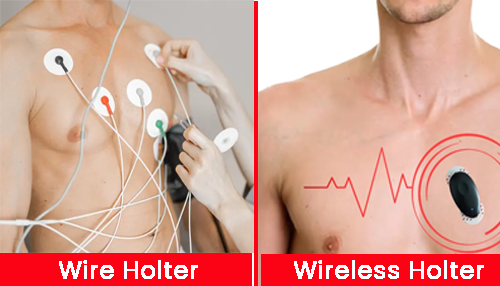
A lead-based Holter monitor uses electrodes (leads) — small sticky patches — attached to the chest, which are connected via wires to a small recording device. This traditional form of Holter monitoring has been widely used for decades and is known for its accuracy and reliability.
How It Works
- Several leads (usually 3 to 12) are placed on the chest area.
- The wires connect these leads to a recording device, usually worn around the neck or clipped to a belt.
- The monitor records every heartbeat continuously for 24–48 hours.
- The collected data is later analyzed by a cardiologist.
Advantages
- High accuracy and proven reliability
- Ideal for detecting complex arrhythmias
- Records multiple ECG channels simultaneously
- Cost-effective and widely available
Limitations
- May cause skin irritation due to multiple electrodes
- Wires can restrict movement or cause discomfort
- Not waterproof — cannot be worn while bathing or swimming
- Visibility can cause inconvenience in public or during sleep
What is a Leadless Holter Monitor?
Overview
A leadless Holter monitor is the latest innovation in ambulatory ECG monitoring. It’s a compact, wireless, single-unit device that attaches directly to the chest without any external wires or separate electrodes. It offers freedom, comfort, and convenience, especially for long-term monitoring.
How It Works
- The device is directly attached to the upper chest using an adhesive patch.
- It records ECG data for up to 7–14 days, depending on the model.
- The data is stored internally or transmitted wirelessly for review.
- Once monitoring is complete, the device is removed and analyzed.
Advantages
- Lightweight, compact, and wire-free design
- Excellent patient comfort and mobility
- Ideal for long-term (up to 14 days) continuous ECG monitoring
- Water-resistant — can be worn during normal activities
- Higher patient compliance and accurate long-duration data
Limitations:
- Slightly higher cost compared to traditional Holter monitors
- Limited battery life (depending on duration)
- May record fewer leads (usually single-channel ECG)
Which One Should You Choose?
Your choice between a lead-based and leadless Holter monitor depends on your medical needs and lifestyle.
Choose a Lead-Based Holter if:
- Your doctor recommends detailed, multi-lead ECG monitoring.
- You need short-term (24–48 hours) monitoring.
- Cost-effectiveness is a priority.
Choose a Leadless Holter if:
- You prefer comfort and ease of use.
- Long-term monitoring (7–14 days) is needed.
- You want to maintain your regular lifestyle without disruption.
At Beatstrack, we provide both lead-based and leadless Holter tests with expert cardiologist review — ensuring precise heart rhythm analysis and personalized diagnostic reports.
Holter Monitoring Price in Delhi NCR
At Beatstrack, we offer:
- 24-hour Holter Test: Starting around ₹2,500
- 7-day Leadless Holter Test (Extended Loop Recorder): ₹9,000
Our services are available in Delhi NCR, Ghaziabad, and Greater Noida, with home-based setup and report interpretation by qualified cardiologists.
Why Choose Beatstrack for Holter Monitoring?
- Trusted by top cardiologists across Delhi NCR
- Home sample collection and device setup
- Fast, accurate, and expert-analyzed reports
- Affordable, transparent pricing
- Patient-friendly, advanced cardiac monitoring technology
Final Thoughts
Whether you choose a lead-based or leadless Holter monitor, the goal remains the same — to detect heart rhythm abnormalities accurately and ensure timely treatment.
Most devices require you to avoid getting it wet during the monitoring period. It’s best to shower before device placement.
Typically 24 hours; depending on your doctor’s advice, it may be 48 hours or longer.
With Beatstrack, you’ll receive the complete report soon after the monitoring period ends — so you can meet your cardiologist quickly.
Yes — the Holter monitor is non-invasive, painless, and does not involve any radiation. Skin irritation at electrode sites is rare but possible
With over 90% of health decisions based on diagnostic results, we are committed to being a trusted healthcare partner. Contact Us